Abandoned
Durability. It’s something that a lot of people look for in their everyday products. For the objects that we buy that have a purpose or function, we often need them to last so that we can reuse them. Even our fragile things, like a glass cup, are made to stand the tests of time.
In art too, we often build things to last. A big part of the idea of the monument was to make something that lives beyond us, that is eternal. But even as art has moved away from the traditional ideas of the monument, we still often make things to last. We Weld our sculptures, We fire our ceramics, We frame our screenprints and paintings, we record and upload and keep multiple digital copies of our art.
Another very driving force, in both our everyday products and also in art, is to be the latest and greatest too. To have the newest the fastest, or to constantly be evolving.
These ideas contradict each other in many ways. Why do we still strive to make our things eternal, if we do not plan to keep them eternally? What happens to them once we are done with them?
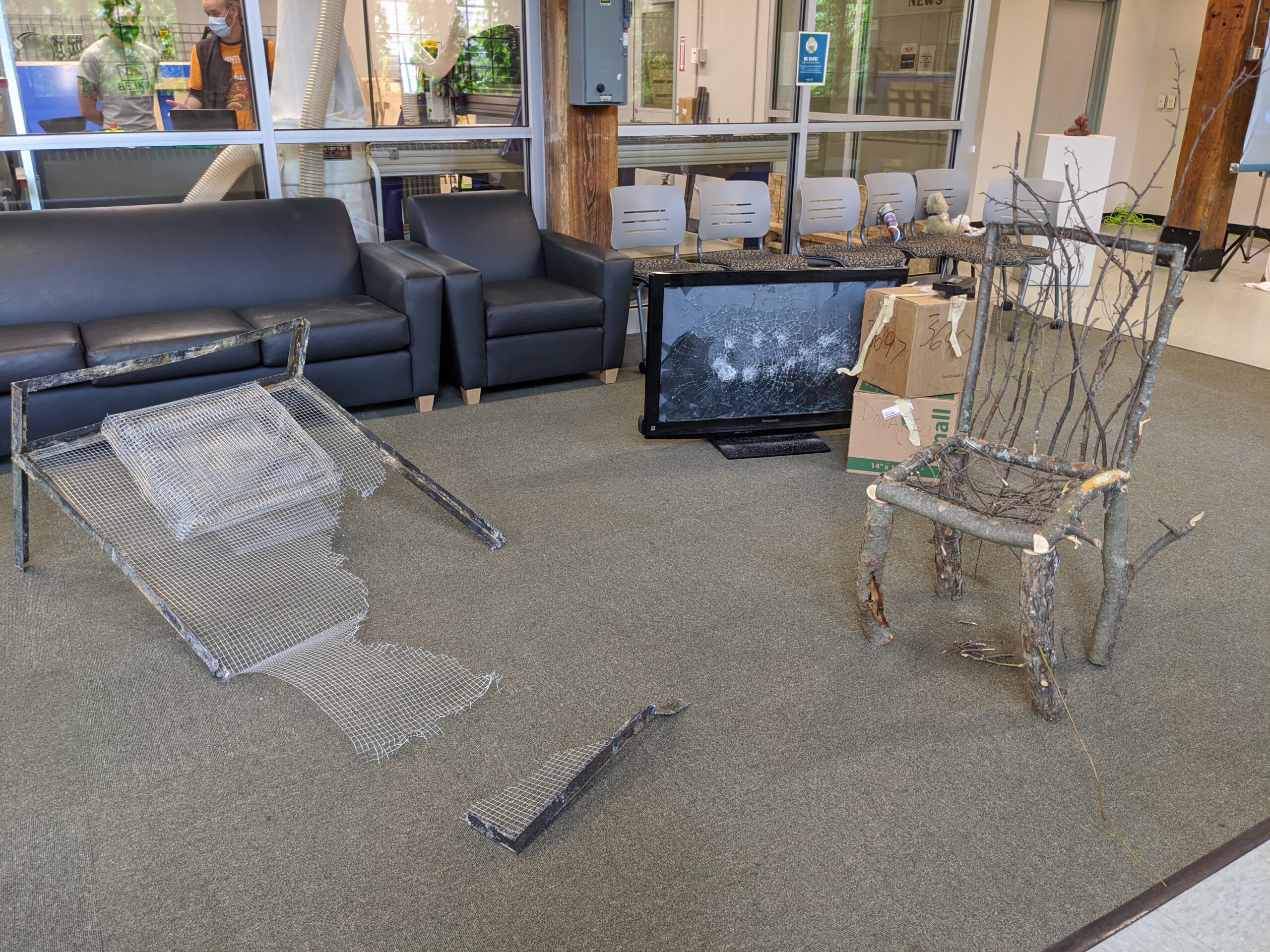
The idea of abandonment was were my concept really started for this piece. A 3D rendition of a Triptych, one part entirely made of metal, one made entirely of wood, and the last a found object to encompass these ideas.
For those of you who may not know, a Triptych is a work of art that is divided into three parts. They are often 2D or a relief carving and were very popular to depict scenes from the bible. Though many artists today use them as a tool to break the canvas and make a piece more visually dynamic.
My Triptych was fully 3D and sat on the floor. I attempted to make all parts life-size, making it easier for the viewer to project themselves into the piece, and interact with it.
Since there are three individual parts that come together to make the piece as a whole, I’ve broken down my process into four different posts. Three of them looking into the creation of each individual part (Metal Bed Frame, Wooden Chair, and Found Technology), and the last (this post) talking about the piece as a whole.
From beginning to end, this piece went through many changes, both in ideation and in physical representation. This I believe was a combination of the fact it had been a while since I had created something like this, and also because I was struggling to really understand what I wanted to convey at first.
Art often has layered meanings, and one piece of art usually never has just one meaning. As an artist, we know this, and for a piece to be successful we often have to be aware of the other meanings people may perceive when they look at our work.
For me, I have my connection to the piece, which no one else really knows, the main idea or connection I want the viewer to have, and then second ideas and meanings I hope that viewer will pick up on.
My own personal connection to this piece would have to be my own struggles with being left behind. Being at this age at the very beginning of adulthood, my life is always changing and moving. Before college I grew up with the same people for most of my life, and though I didn’t have many friends, the ones I did have I cared about deeply. These people aren’t in my life anymore, and though it’s not personal just a part of growing up, it still sometimes hurts me.
This fear has been reinforced my time here at PSU, the few people I have a connection with, I know are only apart of my life for the short time I’m here. When we go home for breaks, we don’t keep in touch. Most of us living far apart. So I know that most likely wherever their life takes them after this chapter, I’m not apart of it. I know logically, that should be okay and that it shouldn’t hurt me the way that it does. But it does hurt, and abandoned in a lot of ways is me processing that. I fear that I care too much for the people I love, and when I try to reach out to them after we’ve all grown into our own lives, they won’t answer. That my friendship will become obsolete.
Now, these are super personal emotions. It’s not something that I ever expect the viewer to pick up on, it’s just my relationship with the piece. This sense of abandonment though is the main thing I do want to convey to them. I wanted them to look at these broken objects and have an intimate relationship with them.
It’s one of the main reasons that the triptych forms a bedroom. A chair, a bed frame, and some old technology are things most people do own, or at one point have owned. Most people have a bedroom, and a lot of people in college have had lived in a couple of different places. These are all everyday objects made to last, that most people use every day but rarely ever think about.
This comes back to something we talked about at the beginning. The two conflicting ideals held by western society, that we create our things to last forever, but then are always striving for the next best thing. Leading us to quickly abandon these objects we’ve created to last a long time, and they are left to just sit. Never truly ever becoming one with their environment, but also decaying enough that they will never be useful to us again.
So how each part of the triptych is similar, supports these ideas. They’re all things that most people own, together they form a bedroom which is an intimate place for most people, and they are all broken and disregarded.
In how they are different represents a lot of the secondary ideas. For instance, they are all made from different materials.
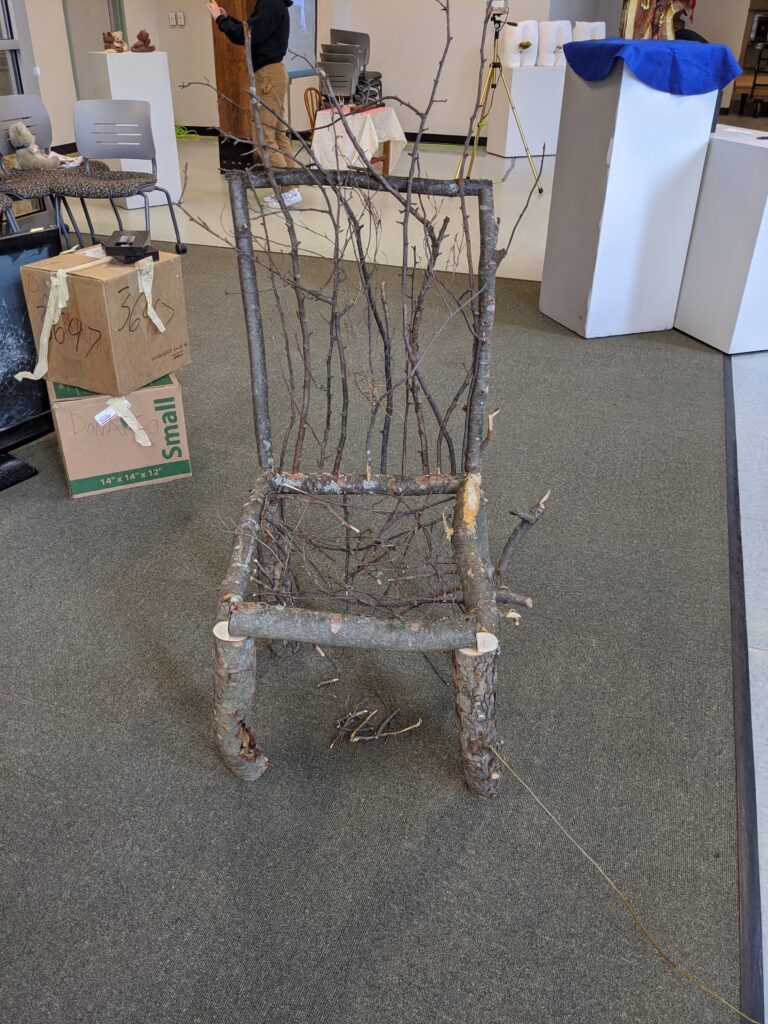
The chair is made from found brush and branches. Which I wanted to represent a pre-industrial time. When we often made things that easily returned back to the earth, and we used them until they were broken. The chair, even though it’s clearly meant to be the oldest, is actually the least damaged. This is to represent the fact that it comes from a time where we valued our things, as well as their relationship to nature. It’s also the least damaged because since it’s made from nature, it never loses its purpose. When it is broken and we leave it to decay, nature will use it as fuel and continue to grow from it.
The Bed Frame is to represent during or after the industrial era. It’s arguably the most aged looking, despite being the second oldest. This is because it’s from a time where we built our things to last forever, not planning to buy a new one every couple of years we needed it to stand the test of time. But then we outgrew it, and no longer needed it. Unlike the chair, it cannot return to nature and it’s purpose has ended so it’s left to rust and decay forever.

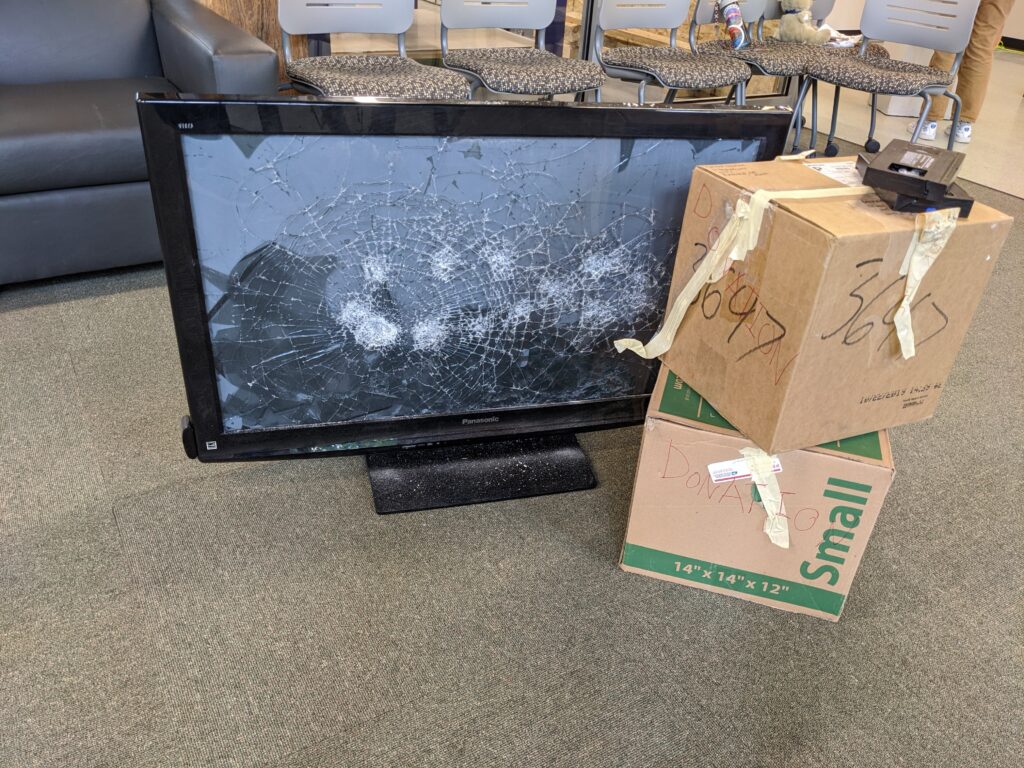
The Technology is to represent present times. It is the least aged looking, but the most damaged, it’s also multiple objects instead of just one larger thing. This is because we have the least respect for our objects in this present time. Often disregarding things before they are really broken, or every couple of years. But even though we only plan to use them for a couple years, we still make them out of materials that cannot return to nature.
Overall I think the piece was successful. I was afraid that my ideas wouldn’t be conveyed clearly, but when doing a class critique my classmates not only picked up on the main ideas, but the other secondary ideas as well.
