Challenging What We are Taught
There is a time in every art student’s pursuit of skill and knowledge that they come upon the age-old division of art and craft. These words have been tools used to separate and explain different pieces throughout history. Some put more value in one category vs the other, some considering the two equally important. Some claim there is no difference at all.
It’s a conversation that has always made me uneasy as an artist and a student. When asked the difference between the two, it was easy enough to find the general answers that questioners were looking for, but I could never commit myself in agreeing that they were necessarily the right answers. Often enough when exceptions to my opposer’s rules were brought up the dismissal was “well there is always going to be exceptions, and art is objective.” But this does not sit right either. Where does one draw the line between an agreed idea with a few exceptions and a disproved idea because it only applies to a margin of things?
It’s a complicated conversation, but the best way to get answers is by asking questions, and even more specifically the right questions. One may start by asking what is art? and what is craft? Easy enough, open up Google on your phone or maybe your computer, type it in and click on the top non-advertisement link.
The following is a quote from a website called Difference Between, which was the first site that popped up on my pursuit for answers, and their definition of craft and art:
“Art is often described as unstructured and open-ended. It has no limitations of expression, just like in painting. Craft, on the other hand, is structured, which means that it has a certain form that is visible.– Unlike craft, art is known to come out of the heart and soul. Crafts come out of the mind and need considerable practice to come out with world-class forms. For example, a piece of painting can create emotions in a person whereas a piece of jewelry or pottery can be an attraction.”
Here is another Definition of Craft from tate.org:
“Craft is a form of making which generally produces an object that has a function: such as something you can wear, or eat or drink from.”
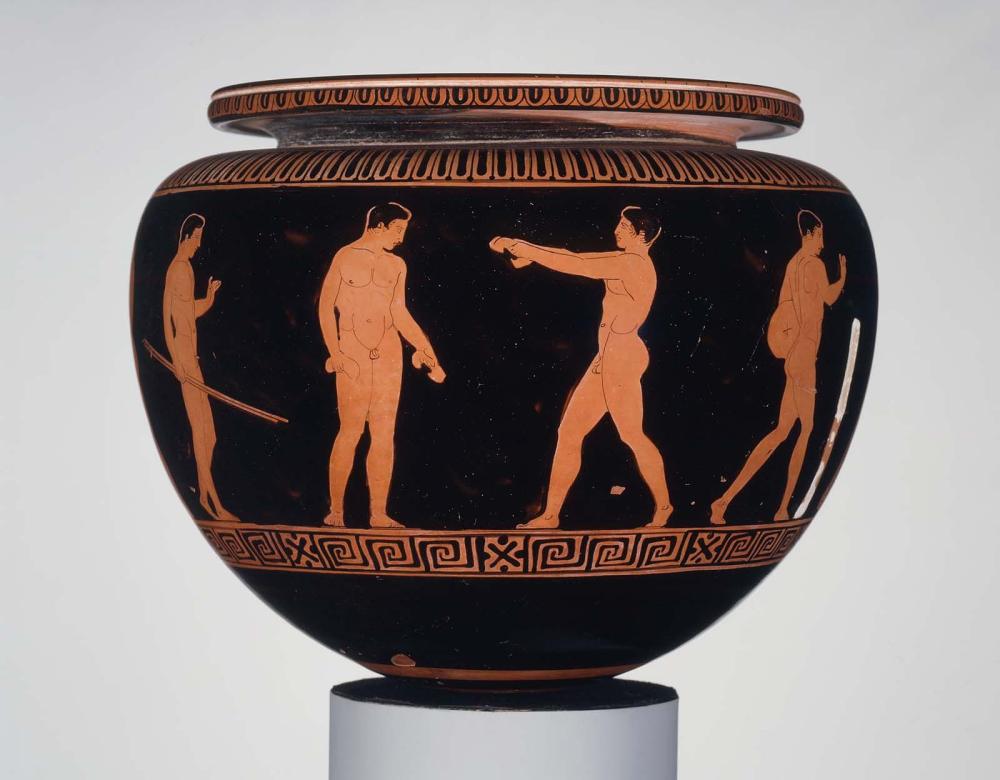
On a surface level, these definitions may work, but once you start trying to apply them things get a little more complicated. If we, for instance, applied some of the works on display at the Museum of Fine Arts Boston, could we successfully apply these definitions to them? Take this Painting for example:

The piece is of several Athens men training, and one playing an instrument. If you saw this in a museum hanging on the wall would you think craft or art? Would it be considered Art or Craft by Our definitions?
What if the painting was actually painted on a functional vase? Does this change whether it is craft or art? If by our definitions it does, why? Is it because it is now three dimensional? or simply because it has a function? What these definitions don’t account for is what if there is a piece that is both made to convey a greater meaning and emotion, and is still functional?
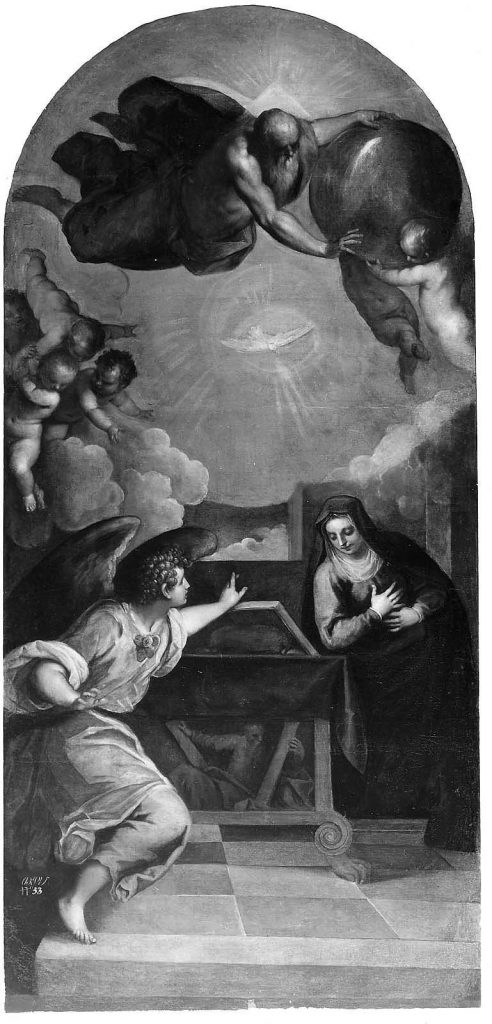
What about this Italian painting commissioned by a church? Is it art or is it craft? What if we considered the time that this piece was estimated to be painted, 1548–1628, and consider that churches before the invention of the printing press, often used art to tell biblical stories to those who did not read or speak the same languages. Is this considered a function? Would that mean that all religious art used by churches and cultures to convey stories no longer be considered art?
And down the rabbit hole, we go. Our questions end up leading to more questions than answers. The more examples we bring up, the shakier our definitions seem to become. This is where everyone starts to get frustrated, and a point where most may say that these are just exceptions to the art and craft debate.
I’d argue though, that the reason our answers do not apply is that we’ve been approaching this problem from the wrong angle. That moment’s like these, are not the times to just accept what is being taught to us, but to question it more so then ever.
Instead of asking What is Craft and Art? Let’s try asking where do the terms Art and Craft come from? And maybe, Why did we ever begin to make the distinction?
Laura Morelli, an American Art Historian, has a short Ted Talk, that begins to really explore this question.
In this, she addresses how at one point in time there was no artist or crafter, instead just guilds of makers. A time where patrons would pay makers as a group instead of separately, and the one commissioning the piece also usually got the credit for it instead of those who actually made it. Then she begins to discuss how some makers began to put value on individual creativity instead of production. Shifting from having patrons pay based on size to pay based on skill and creativity.
One of the biggest reasons for the shift that Laura addresses come after this initial change. When a writer Giorgio Vasari published a book called “Lives of the Most Excellent Painters, Sculptors, and Architects.” that took the public by storm and ended up establishing the idea that things like painting, sculpture, and architecture have greater importance over other media. That they were considered art.
It’s important to take a moment to consider who these people were pushing for this shift. It was the makers in an attempt to make their work and ideas surrounding how to work more valuable. The distinction between the two was born in order to keep Art exclusive, thereby more important.
Something else to consider is this was also at a time and place where western culture was not tolerant of minorities, other cultures, or women. Which Laura begins to touch on in her video as well. She brings up an African mask and Chinese vase, similarly to how we examined a Greek ceramic piece, and Italian religious painting, and begs the question where do these things fall in this idea of Craft and Art?
This exclusive category of Art not only kept out other forms of creating, but it made it easier to keep out other cultures and people. Branding something as craft is still used as a backhanded way to exclude. Worst of all, it’s so integrated into our teachings that if we aren’t consciously making an effort to battle the discrimination, we often do not even realize we are doing it. In a way, when we say this is craft, not art. Are we not really saying this isn’t art because it’s craft?
Take a look at this quote pulled from an article published by Whitney Museum of American Art referring to their show Making Knowing: Craft in Art, 1950–2019.
“Making Knowing: Craft in Art, 1950–2019 foregrounds how visual artists have explored the materials, methods, and strategies of craft over the past seven decades. Some expand techniques with long histories, such as weaving, sewing, or pottery, while others experiment with textiles, thread, clay, beads, and glass, among other mediums.”
Later in the article, they address how many of the artists have decided to explore craft in order to challenge what constitutes as fine art.
“While artists’ reasons for taking up craft range widely, many aim to subvert prevalent standards of so-called “fine art,”
But take note of how the entire article these are visual artists using craft to make art. The distinction is still drawn between the two. Do we as artists not learn to create art the same way one would learn to make what is defined as a craft? Saying they are using craft to make art is still saying, on its own weaving, sewing, or pottery, and things made with the other mediums mentioned are not art already. Even when we as a culture are supporting those types of creating, we still aren’t really.
So where do we go from here? We began by trying to define art and craft and determine why they matter. We discovered that trying to find how culture defines these words led to a way of looking at art with many holes in it. So we then changed our questions, focusing on where this separation comes from, and why we began to use it. Uncovering the true implications of separating forms of creating into these two categories. After knowing all this, do we as artists, and as a society, still, want to continue to make this distinction? Do we need too?
Art Historian Laura Morelli does not think that we do. At the end of her TedTalk, she suggests we retire vague words such as art and craft, for something all-inclusive like visual culture. Though I do not entirely agree, I do believe she has a point.
We as a society, do not need another category of creating to determine whether something is art or not. We are advanced enough and educated enough to decide whether a piece is art not by looking at if it was weaved or painted on a functional object, but by the merit of the piece itself. This not only rightfully opens the door to types of creating that have always been unrecognized, but it also holds creating we automatically labeled as art to a higher standard. No longer letting it as easily slip by because it was made of a media once determined better.
Though I agree with Laura that Art and Craft should no longer be used as a way do divide different forms of creating. I do think the words still hold some merit. So many artists and cultures branded by the word craft have worked tirelessly for the recognition they deserved all along. Many of which have now taken the word that was once meant to keep them out, and used it to show the art world that they are exactly what it needs.
Consider this article published on artsy.net Why the Art World Is Embracing Craft. Which talks about the discrimination surrounding the craft, and how it is truly the future of the art world. Not claiming that these are artists using craft to create art, but wearing the label craft as a badge of diversity and something new. Stating, yes, we have been art all along, but just because you now want to accept us into your exclusive club does not mean we will forget our first given name. What right do we, after years of claiming that craft was lesser, now get to retire the word as they begin to use it to make them stand out as artists?
The Art vs. Craft discussion still matters. Art and Craft as words still matter. What we need to challenge and change as a society, is how we talk and teach about them. No longer should the questions be What is Art? What is Craft? Are they different and why do they matter?
Instead, we should ask Where do the terms Art and Craft come from? Why did we ever begin to make the distinction? and most importantly, realize that its time to stop using craft and art as ways to categorize and separate creation, because it has caused far more harm and confusion than good. Instead, use them as a stepping stone in history. We used to debate whether something was art or craft, but now we know how to determine if something is art by more then just the media it was made in.