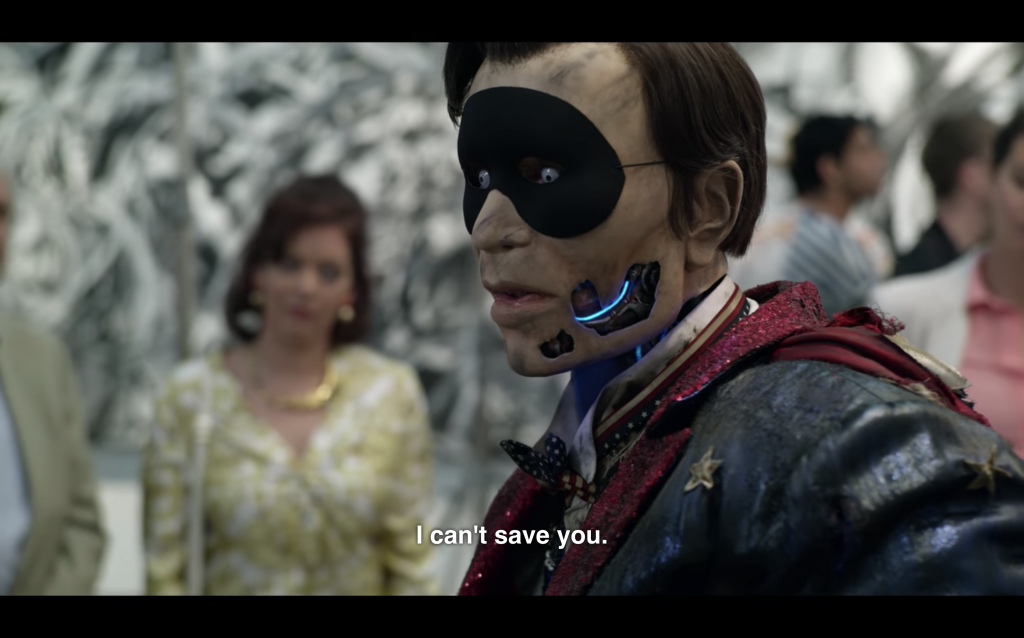
“I can’t save you”

Critics, art historians, and artists alike have been questioning the art worlds social structure for decades. From Roger Fry who shook the art world in the early 1900s with his sudden shift from the Old Masters to Post-Impressionists (due to his theory that Post-Impressionism could be understood regardless of class and education making it the superior art style). To Banksy’s modern controversial street art. We have been questioning the kind of art put in museums and galleries. Is it really there because it is cutting edge and a true masterpiece? Or does its importance simply stem because it is in a museum?
There are two films in particular that really successfully critique this social structure. These are Banksy’s Exit Through The Gift Shop and the Netflix original Velvet Buzzsaw. I will mainly be focusing on Velvet Buzzsaw for this blog post. This is partly because it is a more modern piece, and also because I feel the overly dramatized tone of the films ideas make it more straightforward then Exit Through The Giftshop. Since both films have similar themes I will address Exit Through The Giftshop as well. Using the theoretical lense of film we can begin to break down these two films.
Velvet Buzzsaw has a comedic and gory tone to it. The characters are stereotypical and exaggerated as a way of poking fun at the art world. The art critic Morf Vanderwalt is treated like a god. The older artist Piers is a tortured soul battling alcoholism. The rising new talent Damrish is struggling with trying to keep his morals of why he creates art while still making a profit. The gallery owners and museums collectors are greedy and two-faced. All the characters, aside from Damrish, Piers, and Vertril are very greedy and self-centered.
It’s usually hard for me to get behind a film that makes all its characters unbarring for the sake of making a point. But Velvet Buzzsaw does it in such a comedic way that it actually really strengthens the film. The savageness and drama of their deaths would seem unwarranted if it weren’t for their obsessive greed.
Though the film is very over the top and isn’t a realistic viewing of the art world, the message it is conveying is very real. In the film, Josephina stumbles across the dead Damrish’s art and finds it to be completely captivating. Though she knows it was the artist’s wishes for his work to be thrown out she steals the paintings knowing she can make a profit. From there on every character, except for the artists Damrish and Piers, becomes consumed with either exploiting the paintings to make a profit or keeping the paintings for their own private collections. This greed is their downfall as the paintings are cursed and soon begin to come to life and kill everyone in possession of one.
Now, cursed paintings coming to life and killing people because of their greed is very much fictional. But the metaphor that this stands for, that greed is a poison that is slowly killing the art world, is very real. The exploitation of artists, and the tricks and bribes many of the characters use to raise the worth of the pieces is real as well. How when it becomes more about the money then the art it can turn a beautiful and strong piece into something truly evil. Not possessed by a vengeful spirit evil, but the kind of real evil that lives in the very belly of humanity.
Exit Through The Gift Shop also addresses this greed and the corruptness of the art world. The tone is not exaggerated, and if you did not know a lot about the artist Banksy or the premise of why the film was made, you may think its just a weird documentary. The main focus Thierry Guetta is very eccentric, but not to the point that he is unbelievable. The idea that a man could film and help a group of successful street artists, learn how to navigate the art world from watching them, and then recreate their success for himself is also believable. Even though his art had no real depth or aura, it was enough of an illusion to what had already been established as art that it was widely successful. Why was it so successful? Because a lot of galleries are smoke and mirrors, to begin with, they do the same thing Mr. Brainwash did.
It was not the Art that Thierry was already putting out into the public that got his show traction. It was the fact that he told people he was an already established artist, and he knew the right people to also say this. If the popular street artist Banksy says Mr. Brainwash is legit, then who are the people to question that? Similar to if a highly regarded gallery shows an artist, then they must be important and relevant.
It’s this commentary on the art world that really drew me to these films. The fact that they are also films, is very important. Art Historians often feel the need to write very academically in order to be taken seriously. This can leave a huge part of the world out of the conversation. Having films that can engage audiences and start to get them involved in the conversation is a big step in the right direction. We cannot depend on cursed painting or street artists alone to fix these issues. It’s going to take everyone in on the conversation if we want to make a change.